
重塑人类历史的鼠疫,到底来自哪里|大象公会( 四 )
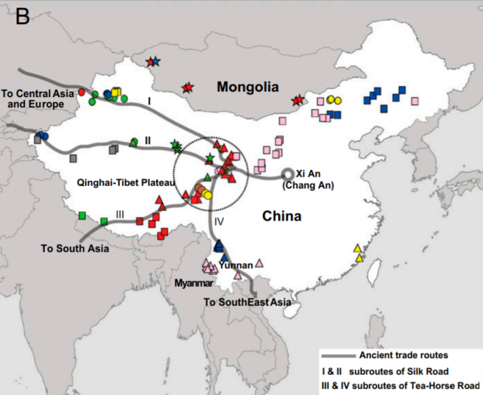
· 据 Historical Variations in Mutation Rate in an Epidemic Pathogen, Yersinia pestis(2013) , 鼠疫杆菌可能源自青藏高原或附近地区而根据 2015 年和 2019 年的研究 , 早在约 5000 年前 , 欧洲便已有人类感染鼠疫杆菌 , 这些鼠疫杆菌的共同祖先可追溯到 5783 年前 。 鼠疫杆菌很早便游荡于欧亚大陆 , 不过早期版本的病菌并没有太强的致病性 , 而且不能通过跳蚤传播 。 在后来漫长时间的演化过程中 , 它才逐渐具备了杀人于无形的破坏性 。从鼠疫的扩散方向以及鼠疫杆菌宿主的分布看 , 自黑海以东至中国「半月形地带」的广袤草原地带(即欧亚大草原) , 都是鼠疫的温床 。历史上 , 商贸、战争、农垦等人类行为都促进了鼠疫的扩散 。 在中国境内 , 主要的自然疫源地为新疆、甘肃、内蒙、青海、西藏、云南等省区 , 分布于长城沿线以北以及藏彝走廊 , 并扩散到东南沿海 。
· 中国鼠疫自然疫源地 / 来源:《鼠疫:战争与和平——中国的环境状况与社会变迁(1230-1960)》追溯鼠疫来自哪里并非没有意义 。 溯源是为了厘清病原体及其传播机制 , 从而避免悲剧重演 。 对于鼠疫如此 , 对于其他疾病也是如此 。鼠疫是一种人畜共患疾病 。 人类新发传染病中 , 有 78% 与野生动物有关 。 2019 年 11 月内蒙古出现的鼠疫病例以及最近的新冠疫情 , 都警示我们进一步妥善处理与野生动物之间的关系 。鼠疫或其他疾病的产生与发展 , 并不受国界的限制 。 它们的威胁对象 , 也不受种族、宗教、意识形态的限制 。 诸如中世纪针对犹太人、女巫等特定人群的污名化 , 才是一种真正的人造瘟疫 。[1] 曹树基:《鼠疫流行与华北社会的变迁(1580-1644年)》 , 《历史研究》1997年第1期 。[2] 曹树基、李玉尚:《鼠疫:战争与和平——中国的环境状况与社会变迁(1230-1960)》 , 济南:山东画报出版社 , 2006年 。[3] 崔玉军、宋亚军、杨瑞馥:《鼠疫耶尔森氏菌的进化研究:从系统发育学到系统发育基因组学》 , 《中国科学:生命科学》2013年第1期 。[4] 李化成:《瘟疫来自中国?——14世纪黑死病发源地问题研究述论》 , 《中国历史地理论丛》2007年第3辑 。[5] 魏兆飞、尹家祥:《中国鼠疫自然疫源地研究进展》 , 《中国人兽共患病学报》2015年第12期 。[6] Aida Andrades Valtuena, Alissa Mittnik and Felix M. Key, "The Stone Age Plague and Its Persistence in Eurasia", Current Biology, vol. 27, no. 23 (2017), pp. 3683-3691.[7] Cui Yujun, Yu Chang, Yan Yanfeng, et al., "Historical Variations in Mutation Rate in an Epidemic Pathogen, Yersinia pestis", Proceedings of the National Academy of Sciences of the United States of America, vol. 110, no. 2 (2013), pp. 577-582.[8] David M. Wagner, Jennifer Klunk, Michaela Harbeck, et al., "Yersinia pestis and the Plague of Justinian 541–543 AD: A Genomic Analysis", The Lancet. Infectious Diseases, vol. 14, no. 4 (2014), pp. 319-326.[9] George D. Sussman, "Was the Black Death in India and China?" Bulletin of the History of Medicine, vol. 85, no. 3 (2011), pp. 319-355.[10] Giovanna Morelli, Song Yajun, Camila J. Mazzoni, et al., "Yersinia pestis Genome Sequencing Identifies Patterns of Global Phylogenetic Diversity", Nature Genetics, vol. 42, no. 12 (2010), pp. 1140-1143.[11] Jacob R. Marcus, The Jew in the Medieva1 World: A Source Book:315-1791, New York: Atheneum, 1979.[12] John Norris, "East or West? The Geographic Origin of the Black Death," Bulletin of the History of Medicine, vol. 51, no. 1 (1977), pp. 1-24.[13] Joseph P. Byrne, The Black Death, London: Greenwood Press, 2004.[14] Michaela Harbeck, Lisa Seifert, Stephanie Hänsch, et al., "Yersinia pestis DNA from Skeletal Remains from the 6th Century AD Reveals Insights into Justinianic Plague", PLOS Pathogens, vol. 9, no. 5 (2013), e1003349.[15] Michael W. Dols, The Black Death In the Middle East, New Jersey: Princeton University Press, 1977.[16] Nicolás Rascovan, Karl-Göran Sjögren, Kristian Kristiansen, et al., "Emergence and Spread of Basal Lineages of Yersinia pestis during the Neolithic Decline",Cell, vol. 176, no. 1 (2019), pp. 295-305.[17] Rosemary Horrox (eds.), The Black Death, New York: Manchester University Press, 1994.[18] Simon Rasmussen, Morten E.Allentoft and Kasper Nielsen, "Early Divergent Strains of Yersinia pestis in Eurasia 5,000 Years Ago", Cell, vol. 163, no. 3 (2015), pp. 571-582.[19] Vincent J. Derbes, "De Mussis and the Great Plague of 1348", Journal of the American Medical Association, vol. 196, no. 1 (1966), pp. 59-62.[20] William McNeill, Plagues and Peoples, Garden City, NY: Anchor Press/ Doubleday, 1976.
推荐阅读



![[萌宠大机密]豪华感与库里南看齐,新款宾利添越SUV亮相!4.4T动力+马鞍棕内饰](https://imgcdn.toutiaoyule.com/20200501/20200501104117573534a_t.jpeg)





- 全人类只有五个人懂自由
- 美国种族歧视为何如此严重呢?
- 为何说美国并没有那么强大呢?
- 欧洲为何无法统一呢?
- 历史的背后|劣迹斑斑的他在狱中收到妻子来信,出狱后疯狂残杀20人,冷血恶魔
- 中国疾控中心称病毒并非从武汉海鲜市场向人类传播
- 历史首次!茅台超越工商银行 荣登A股总市值第一位
- 是哪三个国家推进了人类现代文明世界
- 空间的本质是什么?
- 对于人类生存发展目的、意义与根本价值的再认识